Best Woodturning Tools: A Complete Guide
Whether you're just starting out or upgrading your kit, choosing the best woodturning tools for your skill level makes all the difference. In this guide, we cover every essential tool — from roughing gouges to scrapers — with expert insights from Fine Woodworking contributors like Ernie Conover, Richard Raffan, and Peter Child, plus recommendations across brands like Robert Sorby, Crown Tools, Hurricane, and Easy Wood Tools.
About this guide — I'm Vince, founder of WoodturningOnline. I've been building my tool collection for years — starting with a budget PSI set and gradually adding premium Robert Sorby and Crown tools as I learned what mattered. This guide reflects what I use and recommend from hands-on experience.
Overview Table
| Tool | Link | Description |
|---|---|---|
| Spindle Gouge | Spindle Gouge on Amazon | Known by its shallow flute, used to shape humps, hollows, and flats/tapers (beads, coves, cylinders/flats). |
| Roughing Gouge | Roughing Gouge on Amazon | To turn a spindle blank to round, often beginning with straight sides. NEVER used on bowl blanks. Serious injuries have occurred. Use for SPINDLES ONLY. |
| Skews | Skew Chisel on Amazon | To make planning cuts, peeling cuts, turn beads, shoulder cuts, can be used as a negative rake scraper. Most often used to smooth a cylinder. |
| Parting Tools | Parting Tool on Amazon | Cutting Tool. Sometimes used for scraping. Makes tenons, through cuts possible. Width ranges from thin 1/16" to 1/2" (Bedan) 1/4" width is extremely useful. 1/8 standard. |
| Bowl Gouge | Bowl Gouge on Amazon | Known for its deep flute, bowl gouges are used to shape the outside of a bowl plate or platter. Then used to hollow the interior. Best used for face grain. Many grinds used at turners individual preference. |
| Bowl Scrapers | Scraper on Amazon | Mostly used to smooth difficult changing grain. A small burr is raised during the sharpening process and the burr does the cutting. Short-lived, best used for light finishing cuts. |
Tools can range anywhere from $30 for a 6-piece entry-level set to as much as several hundred dollars for a single high-quality tool. Your tastes and pocketbook should be the determining factors in your choice but once again, high-dollar tools are NOT going to make you a better turner.
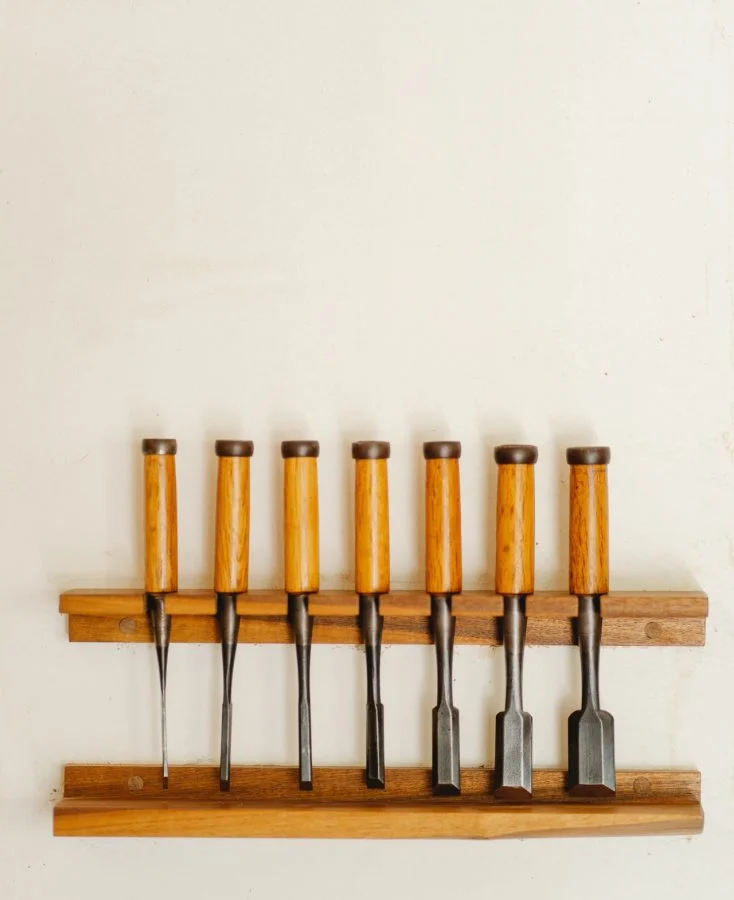
Starter Set
Opinions vary widely on which tools make the best "starter set" for a new turner but the following usually receive a consensus:
Spindle Turning Tools
- 3/8" or 1/2" spindle gouge
- 3/4" skew (or larger)
- 3/4" spindle roughing gouge
- 1/8" or 3/16" parting tool
Bowl Turning Tools
- 3/8" or 1/2" bowl gouge
- 1/2" round-nose scraper
You will also want to put some thought into whether you should purchase individual tools or buy them as a set. There are pros and cons to both approaches. Buying individual tools allows you more flexibility in choosing the size, brand, quality, etc. for each tool you purchase. The most common criticism of buying a set is that you may end up purchasing tools you don't need or use. We tend to agree with this but there is merit in buying a basic budget set to start out with. Budget brands like Benjamin's Best, PSI, and Hurricane offer starter sets in the $60–150 range that let you learn technique without risking expensive steel.
More About Different Types of Tools
The following are some of the basic tools one should be acquainted with for woodturning:
Parting Tool
Parting Tool on AmazonAs the name suggests, this is the tool that is used to part the wood. This tool can also be used to size the diameter of a wood stock and can even be used for scraping. Whether your wood stock is round or square, the parting tool can be used on wood of all shapes.
However, if you are parting the wood between the centers (the midpoint between the tailstock and headstock), you do not want to part the wood all the way as the pieces of timber will simply go flying. Instead, part the wood almost all the way and then turn the wood lathe off to finish the job with a good old saw.
You can also use this tool to cut a spigot into the timber that the lathe chuck can hold onto for easier use.
Spindle Roughing Gouge
Spindle Roughing Gouge on AmazonIf you are working with square stock, this is the tool you will use to make it round. It is a wide tool (typically 3/4" to 1-1/4") with a straight grind and a U-shaped cross-section.
Safety warning: The roughing gouge must never be used on bowl blanks or any faceplate work. The thin cross-section and long unsupported edge can catch catastrophically on face-grain work. This is a spindle-only tool — serious injuries have occurred when turners used roughing gouges on bowls.
This is typically the first tool used on any spindle project. Popular options include the Robert Sorby 3/4" roughing gouge, Crown Tools HSS roughing gouge, and Hurricane Turning Tools budget range. The tool is best for basic shaping, after which you use a spindle gouge or skew chisel for detail work.
Bowl Gouge
Bowl Gouge on AmazonIf the spindle gouge has a shallow flute, the bowl gouge has a deep flute. As Peter Child explained in Fine Woodworking #5 (1976), the bowl gouge is specifically designed for face-grain work — shaping the outside and hollowing the interior of bowls, platters, and hollow forms. By changing the grind angle, you can create bowls of various shapes and sizes.
As Ernie Conover noted in Fine Woodworking #124 (1997), the best gouges are made of high-speed steel (HSS), which holds an edge far longer than carbon steel. Popular HSS bowl gouges include the Crown Tools PM bowl gouge, Robert Sorby Sovereign range, and Hurricane Turning Tools budget-friendly options. For the grind, Mike Mahoney recommends a 40-degree bevel with a swept-back ("fingernail") profile (Fine Woodworking #188, 2006).
With experience, you can even use a bowl gouge for some spindle work, though it's not the conventional application.
Spindle Gouge
Spindle Gouge on AmazonThe spindle gouge will be the tool you use for adding intricate details to your wood stock. It has a shallow flute and the part of the tool that comes in contact with the wood is a fingernail profile point which introduces the details into the wood stock.
This is the best tool for when you want to give the wood stock curved shapes, make coves, beads or add other elements of design to the wood stock.
Skew Chisel
Skew Chisel on AmazonA skew chisel is a tool that is great for finishing. As Richard Raffan detailed in Fine Woodworking #146 (2000), the skew produces the cleanest surface of any turning tool — so clean you practically don't need sandpaper. Raffan recommends practicing grooves and beads before attempting long planing cuts.
The skew is known to be notoriously difficult for first-time users. A common problem is catching the leading edge in the wood, which causes the tool to dig in violently. Raffan's advice: always lead with the center of the edge, never the corners, and keep the bevel rubbing.
Skew chisels come in oval, round, and flat cross-sections. Robert Sorby makes a popular oval-profile skew that reduces the chance of rolling on the tool rest. Crown Tools offers both standard and "fingernail" skews. Alan Lacer, one of the most respected skew chisel practitioners and instructors, has demonstrated that once mastered, the skew is arguably the most versatile tool in your kit.
Extra Tools
These are less common but still useful.
Swept Back Grind Bowl Gouge
The swept-back grind bowl gouge is not too different from a regular bowl gouge. However, the fundamental difference is that it has a different grind. While a regular bowl gouge has a straight grind, the swept-back bowl gouge has a U shape.
The wings of this U-curve act as the cutting edge in this case. This is a very versatile and useful tool that allows you to make different types of cuts for your bowl. The U shape of the grind also allows you to go deep into the bottom of a bowl and ensure a smooth cut.
Scraper
Scraper on AmazonA scraper is another incredible finishing tool that scrapes rather than cuts, leaving the surface of the timber smooth and without cutter marks. The scraper has a burr at its tip, which is the end that comes in contact with the wood stock.
Scrapers are most effective for making the surface of a bowl smooth. There are two common types of scrapers you can use to give your bowl the best finish—the round nose scraper is used to remove marks on the concave side of the bowl (i.e the inside), while the square nose scraper can be used on the outside of a bowl. The latter can also be used to smoothen out the surface of a box and other plane surfaces.
Keeping Your Tools Sharp
Consider your level of sharpening skills before putting money into high-quality, high-dollar tools. Unless you are already proficient at sharpening it makes more sense to start with a basic low-grade set until you have developed some rudimentary sharpening skills. Trust me, tools are like rabbits - you'll accumulate more (and better quality) tools as time goes along. Learning to sharpen on a $100 gouge can be an expensive lesson.
Here's a more detailed post on sharpening.
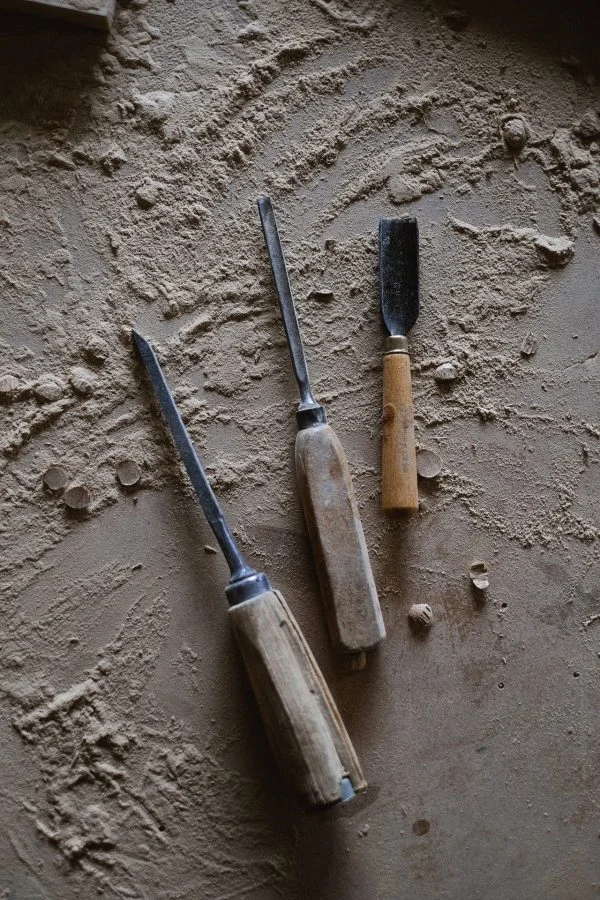
Alternatively, you can also find second-hand tools of good quality that only need a good sharpening. These high-quality used tools may even be more resilient as they will not be brittle, given that they are seasoned.
Using the Tools
Finally, now that you know what woodturning tools are required in your kit, the next concern is using these tools properly. Woodturning and using a wood lathe is certainly not the easiest activity.
You need a lot of practice, focus, and good technique to be able to use the lathe and the woodturning tools well. Besides, safety is always a concern, no matter how experienced you are. The following are some things you should keep in mind about using the woodturning tools that have been described above.
Using the Spindle
The spindle tool is typically what you will use when you are working between centers. When using the spindle, identify the middle part of the wood because that is where the wood stock has maximum balance and you will be able to work on the wood piece without needing to chip away too much.
You can even make a mark on the middle part of the wood before the lathe is started, so you have a reference point when you start with the tool.
It is always important to ensure that the tailstock is fastened tight, but it is important especially so when you are using the spindle tool. Finally, make sure that the tool rest is at the appropriate height so you can approach the wood stock at the right angle.
Roughing
The spindle roughing gouge is what you will use to give your wood stock a rough shape and structure before you move on to adding more details with other tools. You can also use other types of tools to give your wood stock shape, but the spindle roughing gouge has been designed for this purpose and is the most appropriate tool for it.
You will get the best access and control over the wood stock if you work from the top to the bottom. Ensure your tool rest is in the right position so you can angle the tool correctly and let the cutting edge come in contact with the spinning wood.
It is always recommended that you choose a workstation that allows you to maneuver with ease and gives you room to work without any interruptions.
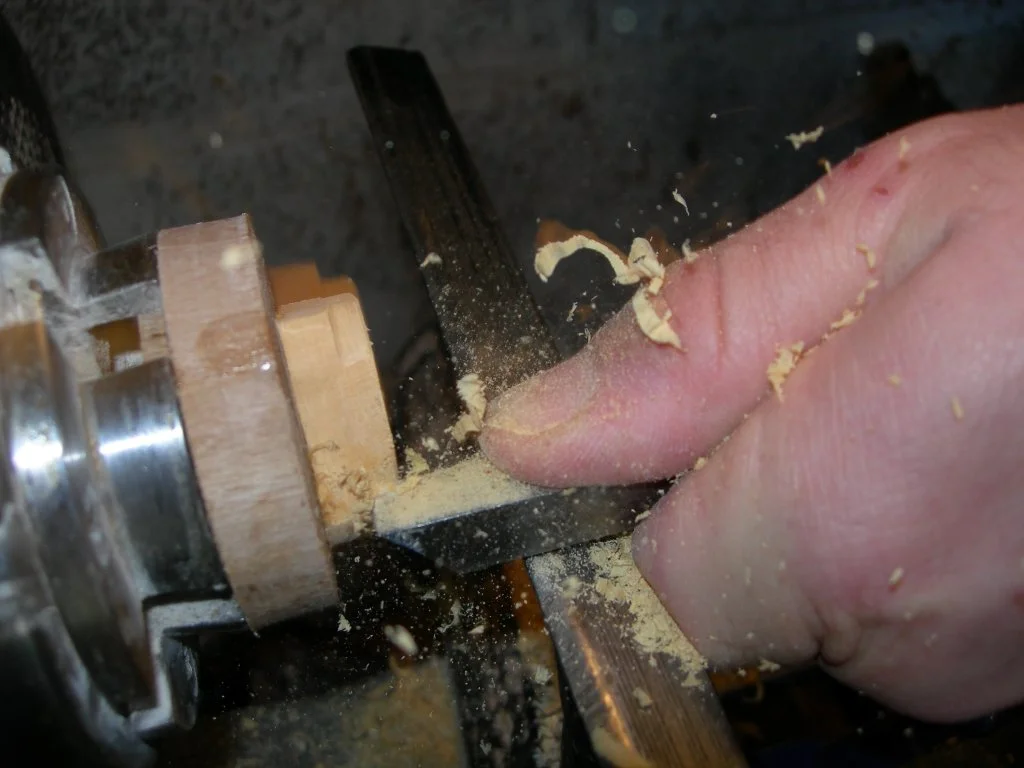 Roughing the wood ring blank
Skew Chisel
The skew chisel, as has been mentioned above, is not the easiest tool to use. It requires some practice and mastering of technique. However, once you have found the right method, it can be a great tool to add details to your projects and experiment with various designs. While using the tool rest, you may even want to raise it higher and approach the spinning wood from the flat end of the tool or the bevel.
This is important because if you approach the wood from the pointy end of the skew chisel, there is a great chance that it might get caught and cause the lathe to glitch. If the lathe is spinning fast, a sudden catch can be shocking and may cause accidents.
You can also use the chisel to make a lot of fine designs and details. You can make a small cut using the pointy end of the tool (be sure to place it on the tool rest properly). Once you have made the incision, approach the wood from the side of the cut and enhance the details accordingly.
Parting Tool
The parting tool is a very useful tool to have in your woodturning kit. Unlike the spindling tool or the skew chisel, you do not need to worry about introducing the bevel first. You can directly apply the pointy end to the wood and let it do the cutting.
Ideally, you should make two cuts with the tool instead of cutting all the way through. This will reduce friction and allow you to get a smoother cut.
If you want to part the wood off, you shouldn’t part the wood all the way using the tool. Cut till most of the way and then use a saw to complete the whole cut. Of course, ensure the lathe is switched off when you are using the saw as you do not want the wood to rotate when you are cutting with the saw.
Bowl Gouge
The bowl gouge is most useful for turning dishes and gives you a beautiful round shape. You can also use bowl gouge as a spindle gouge, but it is best to use the tool for its intended purpose.
You can use a bowl gouge to shape the inside as well as the outside of the bowl. You can try the push cut, which is one of the easiest cuts to make using this tool. You start at the edge of the wood stock, ensuring the tool is at the correct angle, and gradually push your way towards the center of the wood stock.
The idea is to angle the bowl gouge so that it does not dig into the wood. Instead, it gently chips away at the wood to give you the desired shape. Eventually, you will find that the bevel is simply rubbing on the surface of the wood, which gives you a smooth finish.
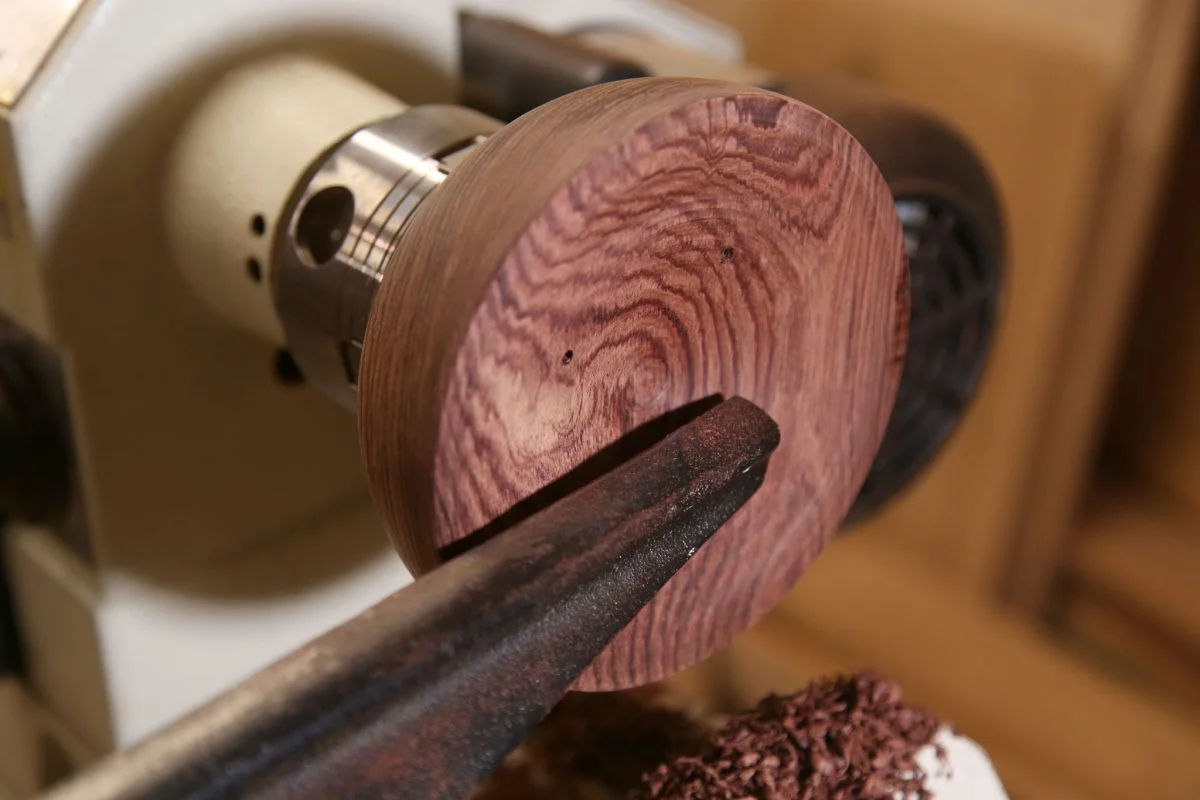 Man working on a lathe using a gouge
Swept Back Bowl Gouge
The swept-back bowl gouge is one of the most versatile and fun-to-use tools. The tool has a convenient U-shaped design which gives you more options for different types of uses.
You can use the wings of the U-end to cut the wood and then slowly drag it back to the edge of the bowl, getting a planing action as well as preventing the pointy end from catching in the wood.
HSS vs. Carbide: Which Should You Choose?
This is one of the biggest decisions new turners face. For a deep comparison, see our carbide vs. HSS guide, but here's the summary:
HSS (High-Speed Steel) tools — like those from Robert Sorby, Crown Tools, and Hurricane — require sharpening on a bench grinder but offer more control and a wider range of cuts. As Ernie Conover noted, HSS holds an edge far longer than carbon steel and is the professional's choice (Fine Woodworking #124, 1997).
Carbide-tipped tools — like Easy Wood Tools, Rockler Carbide Mini set, and Carter and Son's carbide line — use replaceable carbide inserts that never need grinding. Fine Woodworking #116 (1996) covered some of the first carbide turning tools, and by 2013 Rockler's mini carbide set was making the tools accessible to beginners (Fine Woodworking #235).
Our recommendation: If you're a beginner who wants to start turning immediately with minimal setup, carbide tools get you making shavings faster. But if you plan to develop your turning skills long-term, invest in HSS tools and learn to sharpen — you'll have far more versatility and control. Many experienced turners keep both: carbide for quick work and roughing, HSS for detail cuts and finishing.
For a full breakdown, see our carbide vs. HSS comparison.
Tool Brand Comparison
| Brand | Type | Price Range | Best For |
|---|---|---|---|
| Robert Sorby | HSS (UK-made) | $40–120 | Premium quality, lifetime investment |
| Crown Tools | HSS (UK-made) | $30–80 | Good balance of quality and value |
| Hurricane Turning Tools | HSS | $20–50 | Budget-friendly, good starter set |
| Carter and Son | HSS (US-made) | $50–100 | Hand-forged, reviewed in FWW #244 (2015) |
| Easy Wood Tools | Carbide | $80–200 | Beginners, minimal sharpening |
| Rockler Carbide Mini Set | Carbide | $80–130 | Entry-level carbide, smaller projects |
| Sorby Turnmaster | Carbide | $100–180 | Multi-tip carbide system |
| Benjamin's Best | HSS | $15–35 | Lowest budget entry |
What Else You'll Need
Beyond cutting tools, budget for these essentials:
- Lathe chuck: A 4-jaw self-centering chuck (Nova G3, Oneway Talon, or Teknatool SuperNova2) — $80–200
- Bench grinder with CBN or aluminum oxide wheels: For sharpening HSS tools — $80–250
- Face shield: Full-face protection, not just safety glasses — see our safety guide
- Calipers: Digital calipers for measuring wall thickness and tenon diameters — $15–30
- Drive center and live center: Usually included with a lathe, but worth upgrading
We have a full buying guide for lathes here, as well as a list of different lathes with specs here.
Final Thoughts
Good tools don't make you a good turner — your most important tools are your eyes and hands. But the right tools make the learning curve less steep. Once you've built your core kit, explore specialized techniques like when to use a nose scraper, making your own hollowing rig, and adding decoration to a bowl.
Spend time researching each category above to get a realistic idea of your initial costs. A basic starter set (roughing gouge, spindle gouge, bowl gouge, parting tool, skew) runs $100–300 depending on brand. Add a grinder for sharpening and you're looking at $200–500 total to get started.
Invest in practice wood and don't rush to expensive tools. As your skills develop, you'll know exactly what you need to upgrade.
Frequently Asked Questions
Written by Vince
Vince is a woodturner and the founder of WoodturningOnline. He writes tool reviews, buying guides, and turning tutorials to help woodturners at every level make informed decisions about their craft and equipment.