Carbide vs HSS Woodturning Tools: Choosing the Right Lathe Tools
In this article, we compare HSS (high-speed steel) and carbide woodturning tools across the dimensions that actually matter: cut quality, learning curve, sharpening requirements, cost of ownership, and what experienced turners really use. Peter Child (Fine Woodworking #5, 1976) and Ernie Conover (Fine Woodworking #123, 1997) both championed HSS gouges for their shearing cut quality — but carbide tools have earned a legitimate place in the modern workshop.
About this guide — I'm Vince, founder of WoodturningOnline. I own both HSS and carbide tools and switch between them depending on the job. This comparison reflects real shop experience — not theory.
Quick Comparison
| HSS Tools | Carbide Tools | |
|---|---|---|
| Cutting action | Shearing — slices fibers cleanly | Scraping — removes material by abrasion |
| Surface finish | Superior — often needs sanding only from 220 grit | Rougher — typically requires sanding from 120 grit |
| Learning curve | Steep — bevel angle, tool presentation, and body mechanics all matter | Minimal — hold at 90° to the work, no bevel to manage |
| Sharpening | Frequent (every 10-15 min) but fast on a grinder | Rarely — rotate to fresh edge, replace insert when all edges are used |
| Tool cost | $25-80 per tool | $15-50 per tool (inserts $5-15 each) |
| Sharpening cost | Grinder + jig system: $150-250 upfront, then free | None (diamond hone optional, $15-25) |
| Versatility | One bowl gouge can turn an entire bowl — inside, outside, bottom | Need multiple tools (square for outside, round for inside, diamond for detail) |
| Catches | Can be violent — gouge digs in and jerks the work | Mild — scraping action limits catch severity |
| Best brands | Robert Sorby, Crown, Hurricane, Carter and Son, Henry Taylor | Easy Wood Tools, Simple Woodturning Tools, Rockler |
| 5-year cost (regular use) | Lower — tools resharpened hundreds of times | Higher — ongoing insert replacement costs |
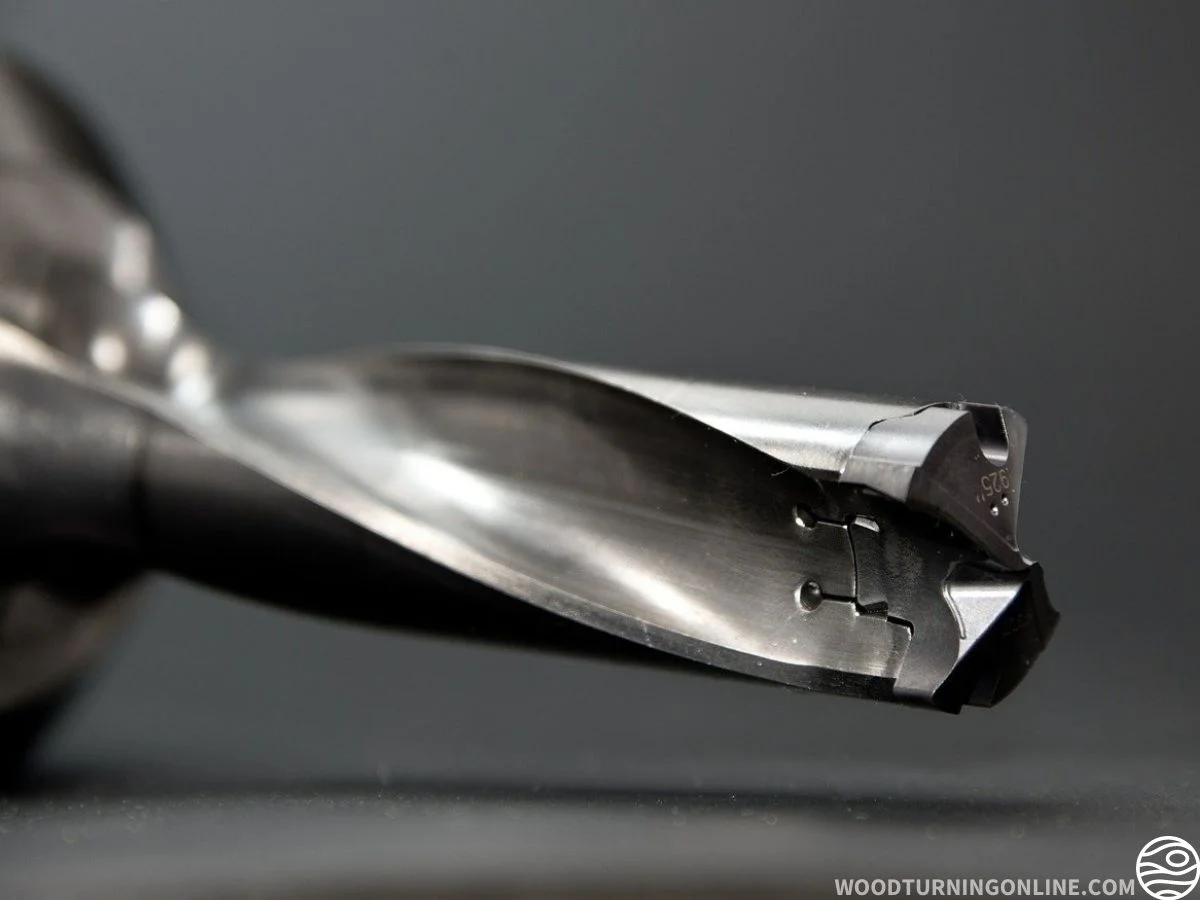
How Carbide Tools Work
Carbide turning tools have replaceable tungsten carbide inserts mounted on a steel shaft. The inserts are extremely hard (Rockwell 90+ HRA vs. 62-66 HRC for HSS) and resist wear far longer than steel edges. When one edge dulls, you loosen a Torx screw, rotate the insert to a fresh edge, and keep turning.
The key difference: carbide tools scrape the wood rather than cut it. You hold the tool perpendicular (90°) to the workpiece and push straight into the material. There's no bevel to ride, no angle to maintain, no tool rotation to learn. This is why beginners can get results immediately.
Insert shapes determine what you can do:
- Square inserts — roughing, exterior curves, cutting tenons
- Round inserts — interior curves, hollowing, finishing
- Diamond inserts — detail work, beads, coves, V-cuts
For our top picks, see Best Full-Size Carbide Turning Tools.
How HSS Tools Work
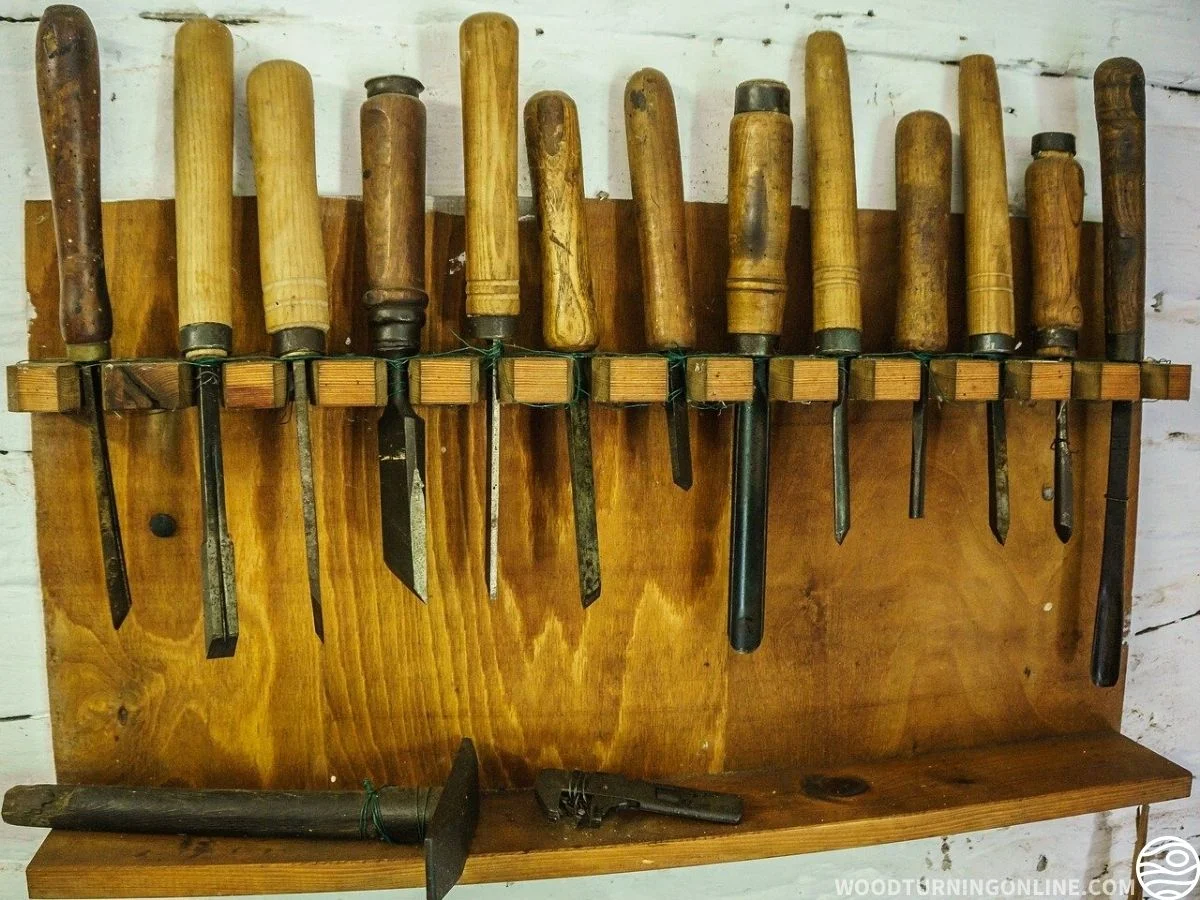
HSS (high-speed steel) gouges and chisels cut the wood with a shearing action. The tool's bevel rides on the wood surface, and the sharp edge peels off a thin shaving. When done correctly, the surface that comes off the tool is smooth enough to need minimal sanding.
This is where the learning curve lives. To make a clean shearing cut, you must:
- Present the bevel to the wood at the correct angle
- Keep the bevel rubbing the surface as you sweep the tool
- Rotate and angle the tool continuously to follow the workpiece contour
- Maintain your body position and weight transfer throughout the cut
As Ernie Conover wrote in Fine Woodworking #123 (1997), "anyone who learns how to handle a gouge with aplomb will be far along the road to mastering turning itself." The technique takes weeks to internalize, but once you have it, a single bowl gouge can turn an entire bowl — outside, inside, and bottom — with nothing but shearing cuts.
HSS tools require regular sharpening — typically every 10-15 minutes of active cutting. Woodworking sharpening systems like the Wolverine jig and Oneway Vari-Grind make this painless: mount the tool, touch it to the wheel, and you're back cutting in about 30 seconds.
For our tool recommendations, see Best Woodturning Tools.
The Real Difference: Cut Quality
This is the core of the debate, and it's not subjective — it's physics.
A shearing cut (HSS) severs wood fibers cleanly, like scissors cutting paper. The result is a smooth surface with minimal torn grain.
A scraping cut (carbide) tears fibers away from the surface, like dragging a fingernail across paper. The result is rougher, with more torn grain — especially in the "trouble zone" of a bowl (where the grain transitions from face to end grain).
What this means in practice: An HSS-turned bowl might need sanding starting at 220 or even 320 grit. A carbide-turned bowl typically needs sanding starting at 120-150 grit. That's not trivial — the extra sanding rounds over detail and can take 15-20 minutes per bowl.
For projects that will be heavily sanded anyway (natural-edge bowls, rough-textured art pieces), the difference matters less. For projects where crisp detail matters (lidded boxes, finials, spindle work), HSS is clearly superior.
Which One Should You Buy?
If You're Brand New to Turning
Start with carbide. You'll be making shavings (well, dust) within minutes of unpacking your tools. The immediate feedback loop — see progress, make something, feel motivated — is worth more than theoretical technique perfection. A 3-piece carbide set ($40-80) gets you a rougher, finisher, and detailer — available at retailers like Woodcraft, Rockler, and Amazon. Pair it with any lathe and you're turning today.
That said: plan to learn HSS eventually. Carbide alone will cap your growth.
If You're a Hobbyist (6+ Months In)
Add HSS to your kit. Get a quality bowl gouge (Robert Sorby, Crown, or Hurricane — $30-60) and a spindle gouge. Invest in a bench grinder and Wolverine jig ($150-250 total). Learn the 40-degree fingernail grind.
Most hobbyists end up using both: carbide for quick roughing, HSS for finishing cuts. This is a legitimate, efficient workflow — not a compromise.
If You're Serious / Professional
HSS is your primary toolkit. A bowl gouge, spindle gouge, roughing gouge, skew, and parting tool (all HSS) cover 95% of turning tasks. You'll produce better surfaces, have more control, and your ongoing costs will be lower.
Keep a carbide rougher in the rack for initial stock removal — it's faster than a roughing gouge for turning square blanks round. But the moment you're shaping, you should be cutting, not scraping.
Professional turners like Mike Mahoney, Stuart Batty, and Richard Raffan work almost exclusively with HSS. That's not snobbery — it's because HSS gives them control over the final surface that carbide can't match.
Cost of Ownership Over Time
The upfront and ongoing economics differ significantly:
HSS setup cost: $150-400 for 4-5 tools + $150-250 for a bench grinder and sharpening jigs = $300-650 total. These machines and jigs are a one-time investment — after that, resharpening is free. HSS tools last decades with proper maintenance.
Carbide setup cost: $40-200 for a tool set. No grinder needed. But replacement inserts cost $5-15 each and last 8-16 hours of active cutting. A regular turner might go through $100-200/year in inserts.
Break-even point: At about 18-24 months of regular use, HSS becomes cheaper. For occasional hobby use (a few hours per month), carbide may never reach the break-even point.
Wrapping Up
Both carbide and HSS tools have earned their place. The worst advice is "pick one and commit." The best workflow for most turners:
- Start with carbide to learn what's possible
- Add HSS tools as your technique develops
- Use carbide for roughing, HSS for finishing
- Keep your HSS tools sharp — a dull HSS gouge is worse than carbide
The tools don't make the turner. Getting to the lathe regularly does.
When to Use Each: Practical Scenarios
The "carbide vs HSS" debate misses the point — most experienced turners own both. Here's when each tool type earns its place:
Use carbide when:
- Turning bowls with bark inclusions, voids, or spalted wood — the scraping action is gentler on fragile areas
- Pen turning production — speed of setup matters more than finish quality when you're turning 20 pens
- Hollowing vessels — carbide hollowing bars (like the Easy Wood Tools Ci5) make deep hollowing accessible
- You're a beginner learning form — get the shape right first, worry about surface finish later
Use HSS when:
- Final finishing cuts on bowls — a sharp bowl gouge leaves a surface that needs sanding from 220 grit, saving 30 minutes of sanding per bowl
- Spindle work — skew chisels and spindle gouges produce a burnished surface carbide can't match
- Sculptural or artistic turning — HSS tools offer more control for detailed shapes
- You want long-term economy — one HSS bowl gouge lasts a lifetime with regular sharpening
Use both when:
- Rough out with carbide (fast, no catches), then finish with HSS (smooth surface) — a popular hybrid approach discussed frequently on r/turning
What the Community Actually Does
Discussions on r/turning reveal that the carbide vs HSS debate resolves the same way almost every time: most experienced turners own and use both.
The typical progression: beginners start with carbide because it's forgiving, then get frustrated with surface quality and long sanding sessions. They invest in HSS tools and a sharpening setup (the Wolverine jig on an 8" slow-speed grinder is the near-universal recommendation). After learning to sharpen and use HSS, they don't abandon carbide — they reach for it when the situation calls for it.
As one turner who made the switch put it: "I started with carbide, got tired of the tearout and long sanding. Switched to HSS. Game changer — but I still grab my carbide tools for spalted wood and rough hollowing."
The community's practical advice for beginners: start with carbide to learn form, but budget for HSS tools and a sharpening system from the beginning. The common recommendation is a single quality bowl gouge (Robert Sorby or Hurricane) plus a low-speed grinder with Wolverine jig — roughly $300-400 total. Learn to sharpen one tool well before buying more.
Frequently Asked Questions
Written by Vince
Vince is a woodturner and the founder of WoodturningOnline. He writes tool reviews, buying guides, and turning tutorials to help woodturners at every level make informed decisions about their craft and equipment.